I Built a Game for 142 Children I Never Met. Here's What Their Taps Said
On 7 November 2026, a community festival for children's cafés (kodomo shokudō) was held in Shiga, Japan. In one corner of the hall stood three portrait touch screens running a small game I had built as a volunteer, for the children who came: Game Hiroba, where kids play four mini-games with a winged egg called Fukuppi and collect a stamp for each one they clear.
- The game
- Four 30-second touch-screen mini-games: cook curry, catch food, match cards, pop popcorn. Children play with Fukuppi, a winged egg, and collect a stamp for each game they clear.
- Where
- A children's café festival (kodomo shokudō) in Shiga, Japan, on 7 November 2026. Three touch screens, 11:00–14:30. I built it as a volunteer. 142 children played 645 times.
- What you can take from it
- 1. Decide what "success" means before you log it. 2. Check your own interface before blaming the user. 3. The people who answer a survey are not everyone.
The game, in one paragraph
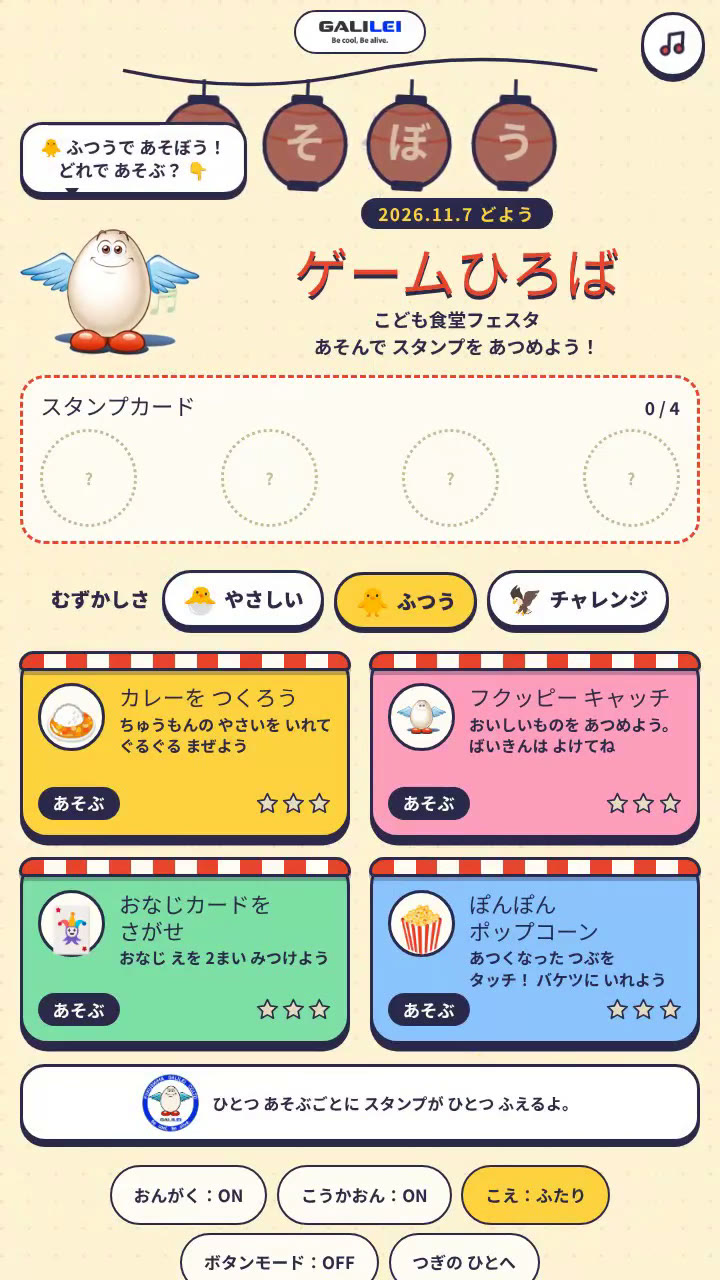
Four games, each about 30 seconds. Curry: drag the vegetables on the customer's order into the pot, then stir. Catch: slide Fukuppi left and right to catch food and dodge germs. Cards: classic pairs. Popcorn: tap kernels the moment they glow. Each finished round shows one to three stars. Clear all four and the screen throws a party, then asks two questions: was it fun? and how hard was it?
Most of the data wasn't the event
The logs held 234 sessions. Only 142 were children at the festival. 57 came from rehearsal days in the two weeks before. Another 31 were logged on the morning of the event, before the doors opened at 11:00, while volunteers set up the screens. None were marked as tests, because test mode was never switched on. Four more were touches where nobody opened a game, and one session claimed to last 157,377 seconds: a browser left open for almost two days.
Taking the totals at face value, I would have reported 234 players. The real number is 142. The logger told the truth about what happened to the software, not about what happened at the event. To get the event, I had to bring in its own timeline (the flyer said 11:00–14:30).
The metric that looked great and meant nothing
My first dashboard draft showed a clear rate of about 88% per attempt. Then I read my own code. In Catch and Popcorn the round ends when the timer runs out, and that is logged as a "clear" whatever happened. One Popcorn round was "cleared" with zero taps. "Clear" didn't mean success; it meant the round ended. The honest measure is the star rating, and it told a very different story.
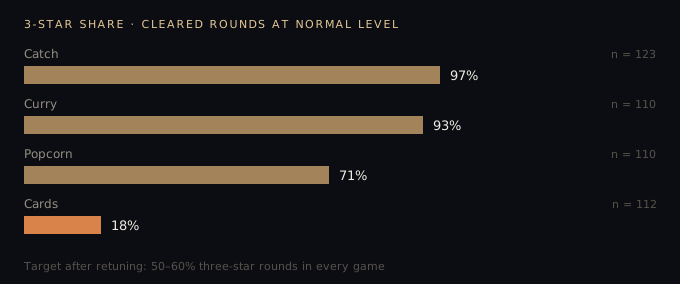
In Catch the median score was 62 points, against a 3-star line of 25 that I set before any child had played. Two games hand out 3 stars almost automatically, and one almost never does. That's a calibration bug, not an insight about children. Next year's thresholds come from this distribution, aiming for 50–60% three-star rounds.
The "frustration" that was really a button
76 attempts were logged as quits. My instinct said frustration, and I started drafting a section about which game was too hard. Then I looked at how long those quits lasted. 70 of the 76 had one second of play or less. Only six attempts in the whole day, 0.9% of 645, were abandoned mid-game.
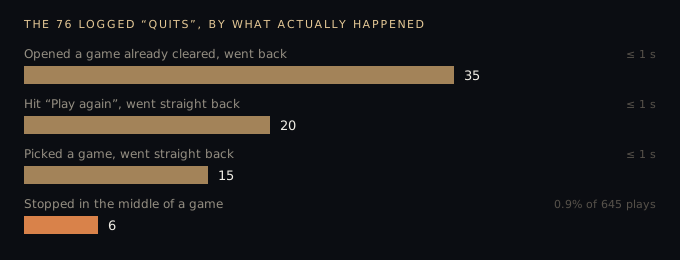
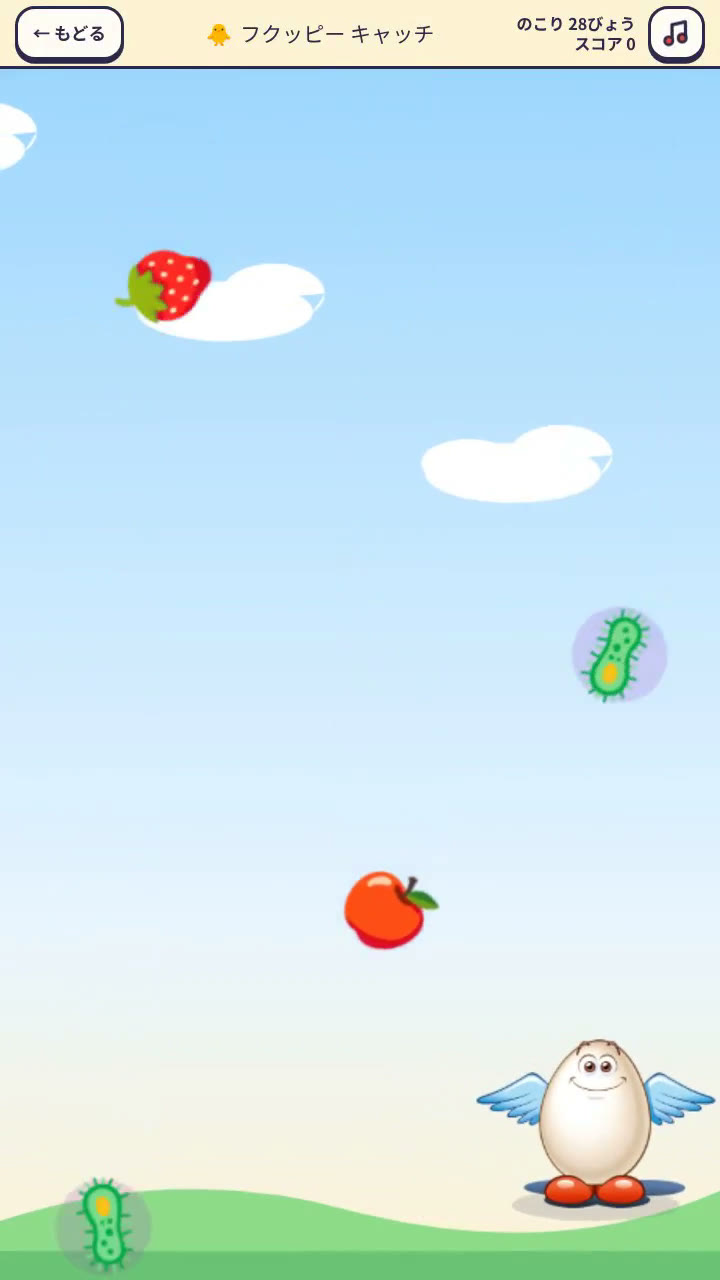
Twenty came straight after a finished round: the result screen appeared, the child hit Play again, then backed out. Eleven of those were in Catch, where your finger is moving the whole time. When the timer ends the finger is still moving, and the big, highlighted Play again button appears right under it. I had locked the hardware buttons on that screen for 1.3 seconds. I had not locked touch.
Before you explain behaviour, rule out your own interface.
A survey that heard from a third of the room
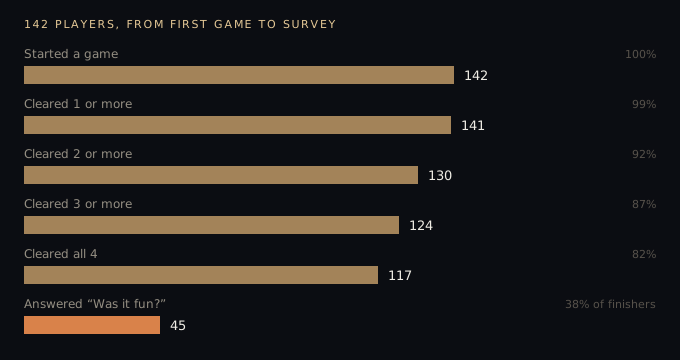
The fun rating looks lovely: 4.36 out of 5, with 91% answering 4 or 5. But the survey only appears after all four games, so non-finishers were never asked. Of 117 finishers, 45 answered. 34 of 52 skips happened within three seconds. One screen collected 61% of its finishers' answers; the other two, 26–27%.
Children who didn't answer had a median of 8.5 seconds before the next child started, against 27 seconds for those who did. My best guess is a mix of queue pressure and fingers still tapping through the celebration onto Skip. Either way, 4.36 is the view of a small, successful group. I report it, but I don't lean on it. Next year the rating moves to one tap on every result screen, where every child sees it.
What did hold up
- Children finished. 117 of 142 (82%) cleared all four games. Of the 25 who didn't, 24 ended with the "next player" button after about as long as everyone else (219 against 225 seconds), which looks like hand-overs, not giving up.
- The booth was full all day. Each screen started a new player about every 4 minutes 12 seconds, from 11:00 to 14:30.
- A third of each visit happened outside the games. Hub, demos, the 3-2-1 countdown, results and survey took a median 64 seconds per finisher. Cutting 30 seconds would let about 13% more children play in the same hours. That may be the biggest practical lever of all.
- Catch was the favourite, with the most attempts (196) and the most replays played to the end (33).
What I'd tell myself before building it
- Decide what "success" means before you log it. A field called
clearwill be read as success by everyone, including you. - Add a test switch and use it, or keep a written timeline of setup and rehearsal.
- Instrument the interface, not just the game. The most useful finding here was about a button.
- Ask everyone, early and cheaply. One tap per round beats two questions at the end.
- Put n next to every number. It kept me honest about which findings were solid (645 plays) and which were hints (six children who said "hard").
I also turned the analysis into a one-minute video and a short report for the volunteers. The best part wasn't any chart. It was learning that a game I had only ever tested myself held the attention of 142 children for nearly four minutes each, and knowing exactly what to fix for the next 142.
会ったことのない142人の子どもたちのためにゲームを作った。タップが語っていたこと
2026年11月7日、滋賀県で子ども食堂のためのフェスタが開かれました。会場の一角には縦型のタッチ画面が3台。そこで動いていたのは、私がボランティアとして、来てくれる子どもたちのために作った小さなゲーム「ゲームひろば」です。羽のはえたたまご「フクッピー」と一緒に4つのミニゲームで遊び、クリアするごとにスタンプが1つたまります。
- どんなゲーム?
- タッチ画面で遊ぶ、1回30秒の4つのミニゲーム。カレーづくり、キャッチ、神経衰弱、ポップコーン。羽のはえたたまご「フクッピー」と一緒に遊び、クリアするごとにスタンプが1つたまります。
- どこで?
- 2026年11月7日、滋賀県の子ども食堂フェスタ。タッチ画面3台、11:00〜14:30。ボランティアとして作りました。142人の子どもたちが645回遊んでくれました。
- ここから学べること
- 1.「成功」の意味は、記録する前に決める。2. ユーザーを疑う前に、自分の画面を疑う。3. アンケートに答えた人が、全員ではない。
ゲームをひとことで
ゲームは4つ、それぞれ約30秒です。カレー:注文どおりの野菜を鍋に入れて、ぐるぐる混ぜる。キャッチ:フクッピーを左右に動かして食べ物をキャッチし、ばいきんをよける。カード:おなじ絵の2枚をさがす神経衰弱。ポップコーン:光ったコーンをタッチする。1回遊ぶごとに★1〜3が出ます。4つクリアすると画面いっぱいにお祝いが出て、最後に「たのしかった?」「むずかしさは?」の2問をたずねます。
データの大半は、イベントではなかった
記録されていたセッションは234件。そのうちフェスタに来た子どもたちは142人でした。57件はその前の2週間のリハーサル、31件は当日11時の開場前、ボランティアが画面を準備していた時間のものです。テストモードを一度もオンにしていなかったため、どれもテストとして記録されていませんでした。さらに、ゲームを1つも開かなかったタッチが4件、157,377秒(約2日間)続いたことになっているセッションが1件。ブラウザの開きっぱなしです。
合計をそのまま信じていたら「234人」と報告していたでしょう。本当は142人です。ログはソフトウェアに起きたことを正しく記録していましたが、イベントで起きたことを記録していたわけではありません。イベントの姿を取り出すには、チラシに書かれた11:00〜14:30というイベント自身の時間割を、データに持ち込む必要がありました。
よく見えて、何も意味していなかった指標
最初のダッシュボード案では、1回ごとのクリア率は約88%でした。そこで自分のコードを読み直しました。キャッチとポップコーンは時間切れでラウンドが終わり、何が起きても「クリア」と記録されます。タップ0回で「クリア」したポップコーンのラウンドもありました。「クリア」は成功ではなく、「ラウンドが終わった」という意味だったのです。正直な指標は★の数で、そこにはまったく違う姿がありました。
キャッチのスコア中央値は62点。★3の基準は25点で、子どもが一人も遊ぶ前に私が決めた数字です。2つのゲームはほぼ自動的に★3を出し、1つはほとんど出しません。これは子どもについての発見ではなく、基準の調整ミスです。来年の基準はこの分布から決め、★3が5〜6割になるようにします。
「くやしさ」の正体は、ボタンだった
「途中でやめた」と記録されたプレイは76回。最初は「くやしくてやめた」のだと考え、どのゲームが難しすぎたのかを書き始めていました。ところが、プレイ時間を見ると、76回のうち70回は1秒以下でした。ゲームの途中で本当にやめたのは、一日で6回、全645回のわずか0.9%です。
20回は、ラウンドが終わった直後でした。結果画面が出て、子どもが「もういちど」を押し、すぐに戻っています。そのうち11回がキャッチ。ずっと指を動かしているゲームです。時間切れの瞬間も指は動いていて、そのすぐ下に、目立つ「もういちど」ボタンが現れます。私は結果画面のボタン操作を1.3秒ロックしていましたが、タッチはロックしていませんでした。
行動を説明する前に、まず自分のインターフェースを疑うこと。
声を聞けたのは、3人に1人
たのしさの評価は5点中4.36点、91%が4か5。とても良く見えます。けれど、アンケートは4つすべてクリアした人にしか出ないので、そうでない子には聞いていません。4つクリアした117人のうち、答えたのは45人。スキップ52回のうち34回は、表示から3秒以内でした。回答率は1台が61%、残りの2台は26〜27%です。
答えなかった子は、次の子が始めるまでの間隔が中央値8.5秒、答えた子は27秒でした。順番待ちのプレッシャーと、お祝いの画面でタップを続けた指がそのまま「スキップ」に当たったことの両方だと考えています。いずれにしても4.36は、少数の、うまくいった子どもたちの声です。数字は載せますが、頼りにはしません。来年は評価を各ゲームの結果画面での1タップに移し、すべての子に見えるようにします。
確かに言えること
- 子どもたちは最後まで遊んだ。142人中117人(82%)が4つすべてをクリア。そうでなかった25人のうち24人は「つぎの ひとへ」ボタンで交代しており、遊んだ時間(219秒)は全クリアの子(225秒)とほぼ同じでした。投げ出したのではなく、交代だったと考えられます。
- ブースは一日中埋まっていた。11時から14時半まで、1台あたり約4分12秒ごとに次の子が遊び始めていました。
- 1人あたりの時間の3割は、ゲームの外。ひろば画面・説明・3-2-1のカウントダウン・結果・アンケートで、4つクリアした子は中央値64秒。1人30秒短くできれば、同じ時間で約13%多くの子が遊べます。これがいちばん大きな改善かもしれません。
- いちばん人気はキャッチ。プレイ回数(196回)も、「もういちど」で最後まで遊んだ回数(33回)も最多でした。
作る前の自分に伝えたいこと
- 記録する前に「成功」の意味を決める。
clearという名前の項目は、自分も含めて誰もが「成功」と読んでしまう。 - テストモードを用意して、実際に使う。それができないなら、準備とリハーサルの時間を書き残しておく。
- ゲームだけでなく、インターフェースも記録する。今回いちばん役に立った発見は、ボタンについてのものだった。
- 全員に、早く、手軽に聞く。最後の2問より、1回ごとの1タップ。
- すべての数字の横にnを書く。どの発見が確か(645プレイ)で、どれがヒントにすぎないか(「むずかしかった」と答えた6人)を、正直に保ってくれた。
分析は、約1分の動画と、ボランティアの皆さん向けの短いレポートにもまとめました。いちばんうれしかったのは、どのグラフでもありません。自分でしか試したことのなかったゲームが、142人の子どもたちをそれぞれ4分近く夢中にさせていたこと。そして、次の142人のために何を直せばいいかが、はっきりわかったことです。